
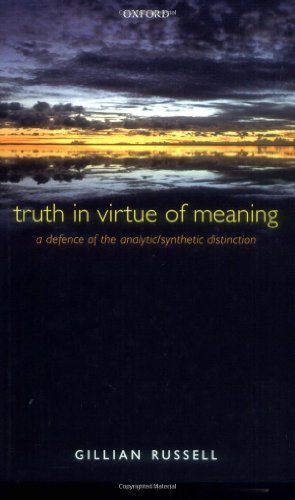
Truth in Virtue of Meaning: A Defence of the Analytic/Synthetic Distinction
Product details
| Management number | 231872149 | Release Date | 2026/06/18 | List Price | US$10.76 | Model Number | 231872149 | ||
|---|---|---|---|---|---|---|---|---|---|
| Category | |||||||||
The analytic/synthetic distinction looks simple. It is a distinction between two different kinds of sentence. Synthetic sentences are true in part because of the way the world is, and in part because of what they mean. Analytic sentences--like all bachelors are unmarried and triangles have three sides--are different. They are true in virtue of meaning, so no matter what the world is like, as long as the sentence means what it does, it will be true. This distinction seems powerful because analytic sentences seem to be knowable in a special way. One can know that all bachelors are unmarried, for example, just by thinking about what it means. But many twentieth-century philosophers, with Quine in the lead, argued that there were no analytic sentences, that the idea of analyticity didn't even make sense, and that the analytic/synthetic distinction was therefore an illusion. Others couldn't see how there could fail to be a distinction, however ingenious the arguments of Quine and his supporters. But since the heyday of the debate, things have changed in the philosophy of language. Tools have been refined, confusions cleared up, and most significantly, many philosophers now accept a view of language--semantic externalism--on which it is possible to see how the distinction could fail. One might be tempted to think that ultimately the distinction has fallen for reasons other than those proposed in the original debate. In Truth in Virtue of Meaning, Gillian Russell argues that it hasn't. Using the tools of contemporary philosophy of language, she outlines a view of analytic sentences which is compatible with semantic externalism and defends that view against the old Quinean arguments. She then goes on to draw out the surprising epistemological consequences of her approach. Read more
Bestseller ranking
Thermal Air Temperature Control Valves



Customers who viewed this product also viewed
Epistemology



Correction of product information
If you notice any omissions or errors in the product information on this page, please use the correction request form below.
Correction Request Form